You’re scrolling through preschool options for your little one, and you keep seeing terms like “dual language immersion” and “bilingual preschool.” Meanwhile, your mom keeps asking why you’d want to “confuse” your child with two languages when they’re still learning to talk properly in English.
Sound familiar?
As LA parents, we’re lucky to have incredible early childhood education options, but choosing between dual language and traditional preschools can feel overwhelming. The good news? There’s actually a ton of research to help guide your decision, and some of it might surprise you.
What Exactly Is a Dual Language Preschool?
Let’s start with the basics. A dual language preschool immerses children in two languages throughout their day-to-day activities. Unlike foreign language classes where kids might learn “hola” and “adiós,” dual language programs use both languages for real learning, story time, art projects, playground games, even snack time conversations.
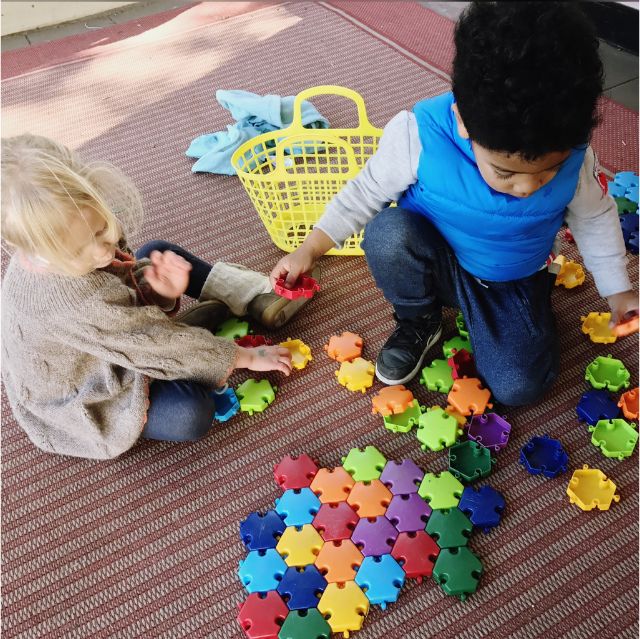
At programs like these, children might hear their teacher explain how plants grow in Spanish during garden time, then switch to English for a math activity with counting blocks. The key is that both languages feel natural and necessary, not forced or artificial.

The magic happens because kids ages 3-6 are in what researchers call the “critical window” for language learning. Their brains are basically language-absorbing machines right now, making connections that become much harder to form later in life.
The Surprising Benefits of Dual Language Learning
Here’s where it gets really interesting. The research on bilingual kids isn’t just about speaking two languages, it’s about how their brains develop differently in pretty amazing ways.
Cognitive Superpowers (Yes, Really!)
Studies consistently show that bilingual children outperform their monolingual peers on tasks requiring focused attention, planning, and problem-solving. Think of it like this: when your child’s brain is constantly switching between languages, it’s getting a daily workout in mental flexibility.
This translates to better executive function skills, basically, the brain’s CEO abilities that help with everything from focusing during circle time to managing emotions during a playground disagreement.
Academic Advantages
Plot twist: kids in dual language programs often perform better on reading tests than their traditional preschool peers, even in English. They’re also more likely to excel on standardized tests later in elementary school.
Why? When children understand how language works in multiple systems, they develop a deeper understanding of language structure overall.
Social and Emotional Growth
Bilingual children tend to be better at perspective-taking: understanding that different people might have different viewpoints. They’re also more skilled at reading social cues and adapting their communication style to different situations.
Plus, there’s something really beautiful about watching a child effortlessly connect with their Spanish-speaking abuela and their English-speaking teacher. That cultural bridge-building builds confidence and identity in powerful ways.

Traditional Preschools: The Familiar Path
Traditional preschools focus on child development through one primary language of instruction (usually English in most LA programs). These programs have decades of proven success in preparing children for kindergarten through play-based learning, social skill development, and age-appropriate academics.
Many traditional programs excel at creating nurturing environments where children build friendships, learn to share, follow routines, and develop pre-reading and math skills. The curriculum is often familiar to parents, and communication between home and school flows easily when everyone shares the same language.
Traditional preschools can be excellent choices, especially when they emphasize play-based learning and social-emotional development. The question isn’t whether they’re good: it’s whether dual language programs offer additional benefits worth considering.
Side-by-Side: How Do They Really Compare?
| Area | Dual Language Programs | Traditional Preschools |
|---|---|---|
| Brain Development | Enhanced executive function, working memory, and cognitive flexibility | Standard developmental progress |
| Academic Preparation | Often outperform on reading tests and standardized assessments | Solid kindergarten readiness |
| Language Skills | Native-level proficiency in two languages | Strong development in primary language |
| Cultural Awareness | Deep understanding of multiple cultures | Exposure depends on classroom diversity |
| Future Learning | Easier acquisition of additional languages | Standard language learning trajectory |
| Social Skills | Enhanced perspective-taking and communication awareness | Age-appropriate social development |
“But Won’t My Child Get Confused?”
Let’s address the elephant in the room. This is probably the most common concern we hear from parents, and it’s totally understandable.
The research is crystal clear: bilingual children are not confused by learning two languages. In fact, studies show that babies can differentiate between languages as early as four months old! Your toddler’s brain is already equipped for this challenge.
Children in dual language programs develop the same level of English proficiency as their monolingual peers: sometimes better. There’s no “delay” or “confusion” phase that hurts their development.

“What If I Don’t Speak the Second Language?”
Here’s another concern we hear a lot: “I took Spanish in high school, but I’m definitely not fluent. How can I help my child?”
Good news: you don’t need to be fluent for your child to succeed in a dual language program. The school community provides that stable, immersive environment where children absorb the language naturally through play, songs, stories, and daily interactions with native-speaking teachers.
Your job is simply to support and celebrate your child’s bilingual journey. Many programs also offer family engagement opportunities to help you learn alongside your little one.
Making the Decision: What’s Right for Your Family?
Consider dual language if:
- You want to maximize your child’s cognitive development during these critical years
- You value the cultural connections that come with bilingualism
- You’re interested in the academic advantages research shows
- You live in a diverse community where bilingual skills are valuable
- You want your child to develop authentic pronunciation and cultural understanding
Traditional preschool might be your choice if:
- You prefer a conventional approach to early childhood education
- You have limited access to quality dual language programs
- Other program features (like specific teaching philosophies) are more important to your family
- You’re planning to introduce second language learning later in elementary school
The Bottom Line
The research overwhelmingly shows that starting dual language learning in preschool gives children cognitive, academic, and social advantages that last a lifetime. We’re talking about a critical window that closes as children get older: waiting until elementary school means missing the optimal time when their brains are perfectly designed for language absorption.
More importantly, there are virtually no downsides. Children in quality dual language programs develop just as well (often better) academically, socially, and emotionally as their peers in traditional programs: with the bonus of genuine bilingual abilities.

If you’re curious about what dual language immersion looks like in practice, explore our philosophy and see how play-based learning and bilingual education work together. Every family’s journey is different, but understanding your options during these precious early years can make all the difference for your child’s future.
Ready to see dual language learning in action? Schedule a tour and watch how naturally children absorb two languages through play, exploration, and genuine connection with their teachers and friends.